discipleship
in chaos
Learn more about who we are by following our blog, written by our pastor, preacher, and chief evangelist. Engage in the everyday sacred as Abby writes about the deep and ordinary all at once.
 I am a rational person who embraces science and I believe in the resurrection.
Let’s start again. I AM a rational person. I can hear my husband laughing right now as I type these words, because he’s seen me lose my cool once or twice. Ignore his laughter; I am rational! Example: when I worry about my kids contracting some horrible childhood illness, I look up the statistical likelihood of someone actually getting that illness. Then, I embrace the rational numbers and move on with my day. When it comes to my faith, I also tend to be level headed. I don’t get hung up on virgin births or single miracle stories. Jesus walking on water? Powerful metaphor, but I am not concerned if it happened or not. I’m the first person to admit I think the Bible is riddled with mistakes and even some blatant mistruths. There are no biblical handbooks with statistics to reference there are for childhood illnesses, but I try to embrace the large sweep of love present in the Bible as my rational guide to faith. And I believe in the resurrection. In fact, I believe in the resurrection hook, line, and sinker. Literally. From a 21st century scientific perspective this is utterly irrational. Perhaps this is just faith. Perhaps this is just hopeful thinking. I’m not sure. But there it is. The belief that Jesus was dead and three days later walked out of the grave, appeared to the women, stuck out his bloody hands to Thomas to reassure him, and then ate fish beside the sea shore with the other disciples who had fled and gone back to business as usual. Yes, I believe it all. A faithful companion along the journey commented: “Sorry, Abby, I can’t worship a zombie.” I respect that and even find the comment comically accurate. So why do I believe in the resurrection? I don’t have an answer. At least not a good answer. I can only offer the following: I believe in God and for this reason, I believe in hope, even when realistic people tell me to be hopeless. I gave up believing that God could single-handedly rescue starving orphans, Haitians from earthquakes, mothers with debilitating depression, victims of violence, struggling families, or trauma survivors tormented by nightmares. So if I believe in a powerless God and every day I encounter the utter brokenness of this world, then what’s the point? I am left with no choice than to believe in a God who does something! I believe in a God who loves. I believe in a God whose love is more powerful, more healing, and more creative than anything we broken humans can imagine. I believe in a God who invites us into a dance of co-creating love. I believe in a God whose love is active in this world through this dance of co-creation. I believe in a God who grants hope to the hopeless. Real hope. What does this have to do with the resurrection? The resurrection is the ultimate expression of God’s co-creating love. God did not possess the sort of military power that could defeat the systematically violent Roman Empire. Hence Jesus died a brutal death on the cross. But God did possess the power of co-creating love that sprang Jesus from the grave. Together, Jesus and God defeated suffering and death with this co-creating love. The resurrection, the defeat of the grave, continues to offer today the final word: Love! This final word gives me hope for the starving orphan, the depressed parent, the individual facing PTSD after a childhood filled with violence, the cancer patient, the Palestinian and Israeli leaders trying to rebuild their communities in peace. The resurrection calls me to dance with love on my darkest days, when I am sure there is only suffering to be found. The resurrection calls me to co-create in this world, instead of sitting and weeping. The resurrection calls me to roll up my sleeves, to pull out my checkbook, to fall to my knees, to utter a prayer, to hold on. The resurrection is God’s final proof that love is more powerful than anything else, even evil, even death. I know that what I believe can be questioned. Pure rationalists can poke holes in my truth. I don’t care. It’s what I believe. It’s the faith of one broken disciple, a 21st century pastor following Jesus, placing one foot in front of the other on the journey, and feeling powerlessness yield to an even greater power—love.
0 Comments
There’s nothing like a bloody, anguished Jesus to ruin your religious experience as a child. Did I just say that out loud? Yes I did. If you need to read the above sentence again, please do. On the cusp of Bad Friday (you might refer to it as Good Friday, but no day a human dies on a cross should be remembered as a good day), I would like to share a very powerful and haunting story from a childhood trauma survivor. This survivor describes their parent as a monster. As a child, they remember peering at the wretched crucifix in their church, Sunday after Sunday. They remember vividly kneeling beneath Jesus’ bloodied body and asking, why would they let this happen to you? Soon the violence of their home was mirrored each Sunday in church as they peered up at the crucifix hanging above the altar. As an adult, even after years of therapy, they have been unable to separate the domestic violence they survived from the vision of Jesus crucified. Imagine the imprint the crucifixion has on young minds. If our salvation comes from Jesus’s crucifixion, then the crucifix teaches children that violence is good. Worse, it teaches them that violence is sacred. For two millennia, the church has blessed violence and elevated it to the sacred. And we have exposed generations of children to this unholy endorsement of unholy violence. Christianity is so often associated with wholesomeness and a sanitary innocence. Children raised in “Christian homes” would never watch an R-rated movie. Instead, they are introduced to clean images of faith: pristine children running through sunny fields to attend church, happy families praying before bed, and all problems neatly resolved at the end of the movie. It’s a bit ironic, isn’t it? Such sanitary images of Jesus and wholesome images of living--- in a faith tradition that divinizes violence. Do you disagree? If you are adamant that the church does not divinize violence, can you please explain why churches are filled with 14 different venerations of the cross that depict every step of the horrifying crucifixion? The worship of the cross idolizes violence.  I have a friend who wears a “lethal injection Jesus” instead of a cross around her neck. Yes, you read that correctly. She refuses to pretend the cross is sacred. By offering an alternative image of Jesus' death, not by crucifixion but by lethal injection, this alarming necklace states the truth: Jesus died by state sponsored execution. There is nothing sacred, nothing holy, nothing acceptable about such a violent death.
Then how are we to mark this significant day in the Holy Week story? Simply with the truth. Jesus died a terrible death at the hands of unjust power. That death cannot and should not be venerated as holy. It should be remembered for what it was: horrifyingly cruel. Recognizing the truth of the crucifixion makes God’s resurrecting and transformative love on Easter morn even more powerful. What should we do with our children on Bad Friday? First, please don’t tell them that a loving prophet was tortured to death to save us from our sins. Second, without question, throw out all of the bloody images of Jesus please! Yes! I would rather destroy thousands of crucifixes than have one more child learn from an early age that violence is sacred. I would also encourage families and religious leaders/educators to teach children the entire story of Holy Week. When it is time to teach children about Friday, name the horror of the cross, making sure children understand that Jesus’ death was awful and wrong. Tell them that God had a different idea about power; that God used God’s power for love. This love is the answer to the violence of the cross, and this love is infinitely more powerful than the cross. That’s where we will find our healing---not in the violence of the cross, but in the miracle of the resurrection; not in useless suffering, but in creative hope; not in the power of empire, but in a community of love. We cannot celebrate the death of an innocent, beautiful man, but we can celebrate God’s victory over the machinations of evil. Please join me in changing the way we tell the story this Friday.  There is a new word I’m hearing a lot these days: deconstruction. As in, I am deconstructing my faith. I’m working with my therapist to deconstruct my past. My favorite, that you might only hear on campuses: I’ve been reading a lot about the impact of colonialism and trying to deconstruct the history I was taught. Try that line at a dinner party and see what happens! Deconstruction feels like a big word. But it’s not really a complicated word. It simply means to break something down. Think of it in terms of Legos. You probably built a Lego creation as a kid. Years passed and you no longer need that Lego-creation collecting dust on your shelf. So you deconstruct the Lego creation, piece by piece, and even get dusty in the process. After deconstruction, you can either reconstruct a new Lego creation (with the doors locked so no one knows you still play with Legos). Or, you can pass on those interesting Lego blocks to someone else while getting rid of all the broken and damaged ones. Deconstructing our past, cultural norms, and even our faith is really the same as deconstructing an old Lego creation. It’s just an internal project. Sadly, in most Christian traditions, deconstruction and reconstruction is not only discouraged, it is prohibited. Many Christian communities hand over a stale, dusty, pre-made Lego creation (dogma, traditions, and a prescribed faith) and demand that not one block be changed. Sounds pretty miserable. These churches should have a sign out front that reads: CREATIVE ENGAGEMENT NOT WELCOMED. I never liked to follow the prescribed Lego directions. And although my eldest loved getting Legos sets for his birthday, he equally enjoyed making new Lego creations out of old sets. When it comes to faith, I’m a lot like my son with his Legos. I am grateful for the traditions that have been passed down to me as a member of a local church and the larger worldwide Christian faith. I also enjoy creating new religious practices in my own personal life that nod to the past while also re-imagining the present. I am simultaneously grateful for the centuries of Biblical scholarship that I depend on as I study the text in preparation for each Sunday’s sermons, even as I flatly reject much of that patriarchal scholarship. I love the rhythm of the Christian calendar, embracing Advent and Lent and Pentecost, while also adding things to the liturgical calendar such as Pride Sunday.  Deconstruction & Reconstruction. Taking apart and building up. This is a fundamental practice in our spiritual lives individually and collectively. It’s not scary! It’s life giving. It’s also biblical.
In Genesis, Jacob, the son of Isaac, and the grandson of Abraham, wrestles with God (or an angel or a stranger--we are not sure). The Hebrew word we translate as wrestle, literally means to kick up dust. After Jacob’s encounter, his wrestling partner renames him Israel--the one who wrestles with God. This name, this shared identity of the Hebrew people, is one of great honor. The Israelites are those who wrestle with God. Later, another Isrealite named Jesus wrestled with his faith. For 4o days and nights Jesus retreated to the wilderness. There he wrestled with his own demons, his faith, and his doubts before he began his public ministry. Lent begins with this story as we begin our own 40 days of wrestling. Kicking up Dust. Wrestling. Deconstructing. Taking apart. Whatever word we use, this is what it means to be engaged deeply with our faith. Faith engagement kicks up questions, misgivings, doubts, and even sometimes traumas. The answer to these encounters is to stand our ground and wrestle with God. We cannot run away. We must deconstruct, so we can REconstruct. In the process, we will discover God. Not the God others might want us to embrace, but the God who offers healing, not the God who demands certain behavior, but the God who loves us, not the God who judges, but the God who runs to us with open arms. This Lent we will look at passages in which Jesus, the wrestler-disrupter, has dust-ups with religious authorities, economic powers, cultural norms, institutional powers, and ultimately with life itself. Jesus got dusty for the well-being of the world and invites us to do the same. As we examine these dusty Jesus encounters, we will get dust all over our spirits. At times it might be exhausting. We must travel to the hard places and get dusty if we are to discover life-giving faith. To be God’s people is to wrestle and enter the wilderness. We will emerge emboldened and ready to reconstruct an authentic spiritual life that brings wholeness not only for ourselves, but for others. Deconstruction and Reconstruction is THE process of faith. This Lent we will get dusty with Jesus as he wrestled and healed, struggled and envisioned, and ultimately offered us a new way of being, the kin-dom. 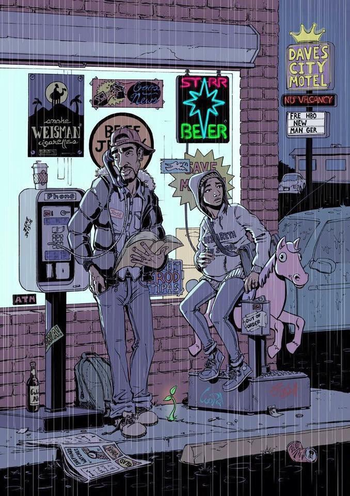 No Room.
Every Christmas Eve service we heard: because there was no room for them at the inn. Flashing hotel signs filled our minds as children. We might have imagined an overcrowded city or no place for Joseph and Mary because back then there were no call ahead reservations. For goodness sakes they rode to Bethlehem on a donkey; of course there were no phones. We were misled. The New Revised Standard Version has updated their translation; now Luke 2:7 reads: because there was no place in the guest room. Joseph’s extended family was from Bethlehem. They could have slept in someone’s home. The truth is his family wouldn't make room for them. They were unwanted. They were unmarried and expecting a child. They were a nuisance. A burden. An embarrassment. No Room for family like that. No Room. 2,000 years later in cities and towns and villages across America there is still No Room. Let me be clear: There is physically PLENTY of room. The average size of a single family home in the U.S. is 2,273 square feet. There is more than enough physical room in America for everyone to have a place to call home. It’s not really about square footage, which we have. Instead we won’t make room. We won’t make room in our hearts, our calendars, our legislation, our lives, or so many other pockets of our communities for those who need room. I witnessed first hand this week that there is No Room for an abuse survivor trying their best to raise their family on an income less than their rent. Nothing in our city of Boston makes this possible. Instead it is a daily grind, a soul-depleting battle, an exhausting and unending trial. I discovered early as a teenager that there was No Room for an outspoken young woman who called out sexual violence. We might congratulate ourselves these days for making room since the hashtag #metoo spread across social media in a week, but do not be deceived. Sexual violence remains rampant. We do not make room for the endless stories of sexual violence from date rape to incest that leave women less than whole. In MOST churches across America No Room is made for LGBTQ+ people, women who desire ordination, teenagers transitioning, noisy children, doubters and questioners or God forbid someone who challenges authority. At the church I serve in West Roxbury we are reminded weekly that many are unwilling to make room for food insecure neighbors parking on the streets waiting for their trunks to be filled with healthy food. Neighbors call the police regularly on our food pantry. There just is No Room for the hungry. I learned first hand how our country makes No Room for undocumented immigrants. My dear friend killed himself after years and years of isolation and hiding, too afraid to drive a car, hoarding cash in his wallet for fear that at any moment ICE would rip him away from his family. Our country's Immigration and Naturalization Services had No Room for Carlos. The world lost a generous and truly kind man. Sadly the list continues. There is No Room for refugees. No Room for the supposedly unpatriotic. No Room for educationally expensive children. No Room for returning citizens who have served their time and are trying to put their best foot forward. No Room for those struggling with addiction. No Room for the visibly poor. The question we must ask ourselves this Christmas is a difficult one. Is there really No Room? Or are we unwilling to make room? Let us all resolve to make room for all of God’s beloved people, and to be surprised by the new life that appears in that very big room. Tribe. That’s the word my husband has been using a lot lately as we discuss the world. We are all divided into our own ethnic, socio-economic, political, and religious tribes. Others use the word silo, but I think this refers more to the limited interaction individuals have with others outside of their social media “tribe.” Truth be told, in our global world, different tribes bump up against each other constantly in the marketplace, voting booth, school, and even home.
Tribes are, for a lack of a better word, “tribal.” Tribes tend to be fiercely protective of their identity, celebrating themselves as the best. If you aren’t following, think white parents shouting at black children during school integration in the 1960s. Think, junior high bullies in the lunchroom enforcing a code of cool and uncool. This is tribal behavior. Jesus was anti-tribal. He included everyone the cool kids make sure don’t sit at their lunch table: Samaritans, divorced women, tax collectors, lepers, migrants, the poor, and more. Jesus’ central message-- love your neighbor-- is a direct challenge to the tribalism of his particular time and place. American politics are incredibly tribal these days, leaving our country divided in ways that leave us afraid. But this isn’t particularly new. Our democracy is rooted in a two-party tribal system. Sadly, American Christianity is more tribal than American politics. Drive down the main street of any American town. There will be multiple churches, often of different ethnicities, that rarely interact with each other, even in small towns. They follow Jesus of Nazareth who commands us to love our neighbors, but when can we love our neighbors, if we never meet them? American Evangelicals and Fundamentalists believe their brand of Christianity is the only way. I have been accused of not being Christian (most often ironically by evangelical women), which is in itself a little funny, since I have spent my life serving the Gospel as an ordained Christian minister. What they are really trying to say is that I am not the right kind of Christian. Tribal. My favorite secret pastime is throwing stones. My internal dialogue goes something like this: Those folks are tribal, accusing me of not following Jesus just because I am an ordained woman. They clearly haven’t read the parts in the Bible where Jesus includes women in his ministry. Why do they think they are so Christian? Hmmm…. Sounds perhaps like I'm being just as tribal. Or…I proudly wear a t-shirt that reads, “God loves the people you hate.” Maybe I should remember that t-shirt is speaking directly to me since I have a long, secret list of people I hate. Again, tribal. This fall I have decided to resist this Christian tribalism in a concrete way. I am the pastor of two progressive Christian churches that work tirelessly to include everyone who walks through their doors. In one church an adult with developmental disabilities yells joyfully during service; her cries are met with smiles and later conversations during coffee hour. At another church, we are so concerned a member who uses a wheelchair feels included, nothing happens anywhere that is inaccessible. Both communities make a concerted effort to welcome LGBTQ+ folks and non-christians (yes, don’t tell anyone but both communities are filled with agnostics and people of other religious traditions and even married same gendered couples! Say it isn’t so! Once again, I’m being tribal.) Yet I wonder: would an evangelical, spouting born-again theology, walking into either church, be welcomed? I’m honestly not sure. In the progressive Christian church Evangelicals are akin to Samaritans in Jesus’ ancient Jewish tradition. There are lots of things that the Evangelical church has gotten wrong and many more things they have professed that have hurt others, such as the exclusion of LGBTQ+ persons and female pastors. I believe it is wrong that the Evangelical church weaponizes the Bible and does not recognize other religious traditions as being equally important paths to living meaningful lives connected to the divine. AND… There are things that the Evangelical church does really well! Have you ever been to an evangelical youth group or prayer gathering? There are lots of things we can learn from these fellow Christian’s without engaging in tribal culture wars. That is where I am. A pastor on the verge of preaching about what we can learn from the Evangelical Church. Currently my list includes church attendance, evangelism, giving, prayer, conviction, and assurance. I am sure more topics will emerge. I am also certain by the end of the fall I will be exhausted by my inter-religious foray and return to my tribal silo. But I also hope maybe, just maybe, more bridges will be built, some of us will be less afraid of the Evangelical Church, and we will learn a little more about what is at the very heart of Jesus’ gospel.  Yep, that’s right, PRIDE is a Christian Holiday! What authority do I have to make that pronouncement? About the same authority the early Christian church did when they proclaimed Jesus was born on December 25th, which also happened to be the rival Sun-God’s birthday. I also claim the same authority the early Protestant church did when they regularly celebrated Reformation Sunday at the end of October. The question isn’t really if I can decide PRIDE is a Christian holiday. The question is: Why don’t all Christian churches celebrate people as their authentic selves? Why do some Christian churches still force some members, whom God knows and loves perfectly, to hide their authentic and beloved selves? In progressive churches, people can be their authentic selves. And at Grace Community Boston, PRIDE Sunday is a big celebration every year. This is why we celebrate PRIDE!  #1 WELCOME! Jesus offered radical hospitality to everyone. For Jesus, there were no insiders and outsiders, included and excluded, pure and impure. There were only people, and he loved them all, including: tax collectors, lepers, sex workers, and Samaritans. At Grace we want to extend a LOUD & CLEAR welcome to folks in the LGBTQ+ community as they are. Pride Sunday is one way of communicating Jesus’ radical hospitality to everyone, especially those who have often been excluded.
#2 LGBTQ+ are God’s BELOVED! The vast majority of Christian churches in America condemn people in the LGBTQ+ community. @GCBoston we make a bold stand as progressive Christians on PRIDE Sunday that LGBTQ+ individuals are beautifully and wonderfully made. We are all God's beloved and we are each an integral part of God’s beloved community. Every year on PRIDE we serve rainbow communion (usually cookies decorated in all the colors) to express clearly that there is room for everyone at the table: gay and straight, non-binary and cis-genered, tall and short, rich and poor, documented and undocumented. This is the splendid, various, diverse body of Christ that Paul described in Romans 12 and Corinthians 12. #3 PRIDE is about MORE than LGBTQ+ issues. PRIDE is about extending God's radical love to all people. Just as the 1960s civil rights movement was about more than racial integration, PRIDE is about accepting everyone for who they are instead of placing everyone in the same narrow social box. You are who you are, and that is who God made you to be. PRIDE reminds us that God doesn’t want us to be anyone else, so we don’t have to fit into any preconceived identity. @GCBoston, PRIDE expands our hearts to celebrate all the variations of God’s creation in our community. And that is healing to all of us. #4 We are queer. Grace Community Boston isn’t a bunch of straights trying to be hospitable to a bunch of queers. We’re already diverse, a mixture of sexual orientations, gender identities, abilities and colors and complexions. We’re a diverse community that loves the diversity of God’s creation. At Grace, we follow Jesus and we are confident Jesus would be decked out in rainbow colors if he lived amongst us now, embracing all those who have been shunned simply for being who they are. God made us who we are. Jesus loves who we are. And Grace welcomes who you are.  The Reasons I do not want to remain a Christian
AND The Reasons I remain a Christian
That’s why I’m still a Christian. Truth be told, most of the reasons I sometimes don’t want to be a Christian have to do with other churches, not the progressive christian church. I apologize if this sounds self-righteous or triumphalist, but progressive christianity believes in equality, science, progress, inclusion, and justice. Some really, really loud churches actively reject all those values and receive a lot of media attention for doing so. But not the progressive christian church that meets coffee house style on Sunday nights. We just follow Jesus, try to love each other and the world, and work toward a better future, together. And that’s why I remain a Christian.  Full Bellies in Boston
I am deeply proud of my city, Boston, for an unusual reason. It has nothing to do with one of our famous sports teams. Instead it’s about school lunch: If you attend a Boston public school, regardless of your income, you will receive a free breakfast, snack, lunch, and then final snack if you are in an afternoon program. That is enough calories for a single day, even if you do not have dinner. Many cities provide free meal programs for school children, but there is often a complicated documentation system that places the burden of proof on families. More often than not, school social workers need to track down documents that are never received. Children inevitably slip through the cracks. More complex than documentation: food insecurity cannot be easily calculated on paper. Some children do not qualify who are food insecure. Boston decided in 2013 that full bellies were as important as curriculum. Boston ditched the red tape. All children can eat their fill in the Boston public school system. Then Mayor Thomas Menino said it simply: “Every child has a right to healthy, nutritious meals in school.” He then noted the complications of the application system: “This takes the burden of proof off our low-income families and allows all children, regardless of income, to know healthy meals are waiting for them at school every day.” (BostonPublicSchools.org, BPS Offers Universal Free Meals for Every Child). The church where I serve has partnered with a local school in Boston. The school social worker noticed that children were stuffing their pockets with food on Friday afternoon. And on Monday morning, they couldn’t get enough food into their empty bellies fast enough. Through our food pantry, Rose’s Bounty, we send children home with bags of kid friendly food each Friday to see them through the weekend. Ever since Covid left our city locked down and our school system closed, I have worried and worried about this particular group of children. I have prayed for them, wondering if their bellies ache at night. The city of Boston has done an excellent job, as have many cities, providing food assistance through local community organizations and at central localities. Our church has offered a weekly pop up food pantry in the school recess yard to try and reach families in need. And still we know that there are children who are malnourished because they do not have the consistency of school breakfast and lunch each day. Visible Disparity & Free Lunches When my mom was a child growing up in Buffalo, New York, she walked home everyday for lunch. School lunches were not provided in her neighborhood school, or in most schools in the early 1940s. And without official school lunches, kids could see how hungry each other were. In Harper Lee’s To Kill A Mockingbird, we see how this wealth disparity plays out during the school lunch. The main character, Scout, comes face to face with poverty for the first time when her older brother, Jem, invites a classmate named Walter home for lunch. At the Finch home, Walter greedily pours molasses all over his meat and vegetables to Scout’s horror. Scout, of course, does not remain quiet. Calpurnia, the Finch’s house keeper and mother of sorts, calls Scout into the kitchen and scolds her for her rude behavior. She explains to Scout that not everyone has as much to eat as Scout. Scout's behavior is not uncommon. I remember vividly bragging about the pot of change my dad left in our kitchen for our school lunches and how my brother and I took however much we wanted (my parents didn’t know this, but they also didn’t monitor). With the extra money we bought ice cream bars and chocolate milk. A classmate was awestruck at this unrestricted access and told me her mother carefully counted out her lunch money each day. My family wanted for nothing; I learned this for the first time at school lunch. Two things happened in America that created the school lunch programs that were the norm when I entered school in 1980. First, women began organizing. It started small, a mother noticing a child with no lunch. These mothers brought children into their homes at the noon hour and made sure they received a filling lunch. This was more common than you can imagine. Soon women were showing up at schools with pots of soup and slices of bread to make sure all the children were fed lunch. Boston led this movement and was the first school district in the country to offer lunches to all students in the late 1890s. The Boston free lunch program was led by the Women’s Educational and Industrial Union. In 1908 in Manhattan, students paid 3 cents or less for pea soup and two slices of bread offered by the Women’s Missionary Society. Second, school lunches became federally supported immediately after World War II. Many young men drafted into World War II couldn’t fight due to malnourishment. Present Truman’s legislative response was simple: the 1946 National School Lunch Act provided affordable meals so kids could grow up to be strong soldiers and strong citizens. The Importance of School Lunches in the Era of Pandemics There are things we simply take for granted. They have been such a part of the common fabric of our communities that we stop noticing. During this pandemic, I have become aware of just how impactful the 1946 National School Lunch Act was on our country. In fact, I have come to realize school lunches are central to our democracy. Let me explain. My rationale is simple. I will confess that although my experience is limited, my work at the Chittick School has given me a bird’s eye view into the terrible domino effects of food insecurity on education. Children can’t learn on empty stomachs. It’s hard for me to imagine anyone disagreeing with this statement. And an educated populace is essential to democracy. As democracy took root in America, public education became not just an ideal, but an imperative. An enlightened public, the founders believed, was essential to self-government. Thomas Jefferson wrote, “Education is the anvil against upon democracy is forged.” If education is essential to self-government, and school lunches are key to children’s ability to learn, then school lunches are central to our democracy. I am not a public health official, and I am not challenging in any way the closure of schools. I do want, however, to offer the following observation: sitting down every day in a cafeteria with classmates, at the same table, in the same room, eating from the same lunch trays, is one of the greatest achievements of our democracy. At that cafeteria moment, we are saying to each child in America, “You matter. Your very physical well being matters. Your education matters. Your voice matters. Your experience matters. Your future matters. You are a citizen of this country and one day we will depend on you to uphold our democracy.” So why does any of this matter to a Christian Disciple? As followers of Jesus, seeking, fighting for, and securing justice is our job description. Sister Simone Campbell said it most clearly when she asserted that salvation is communal. Therefore, justice is how we measure salvation. The measure of justice is how well we do together, as a nation. My salvation is completely tied up with a child sitting down to eat lunch. If that child is hungry, so am I. If I do not fight for justice for that child, I am not closer to salvation. Our destinies are entwined. Jesus called all of his disciples, those who were constantly clueless, those who would deny him, those who would betray him, to eat of bread and drink of cup with him. In that upper room, Jesus made it clear there was only one table and at that table there was room for us all and there was enough for us all. Just as Simone Campbell asserts, Jesus saw salvation as a fully communal endeavor. I like to think of the Boston Public School system’s lunch rooms like Jesus’ table. Everyone is welcome. There is enough for every child. The salvation of each child at each rickety cafeteria table is forever bound up with those who sit across from them, and with me, and with you. Those women who sought free lunches for all children worked not only for our justice, but for my salvation.Thank you. 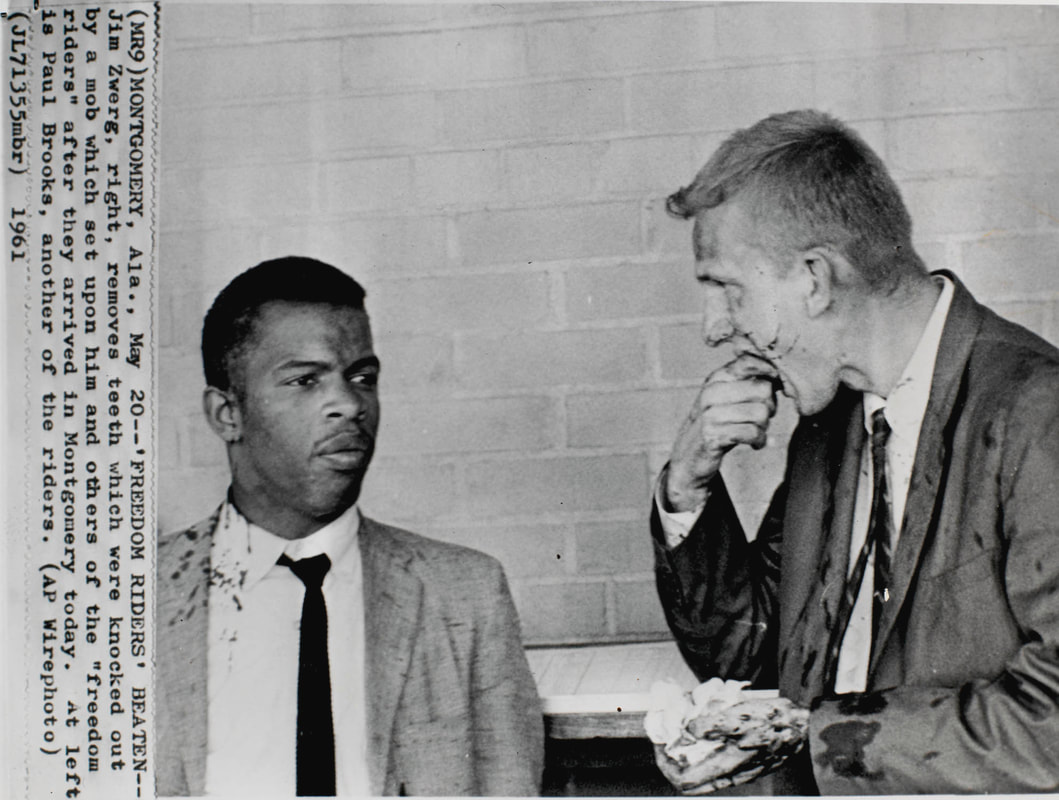 As promised, here is the first installment: a “snippet” of life to glean hope and inspiration. I begin with John Lewis, the man who inspired this blog series.
I was on my parent’s bed. I couldn’t have been older than 11 or 12. The windows were dark, my father was barely awake beside me, the old Philco TV flickered black and white footage from the PBS documentary on the Civil Rights Era, Eyes on the Prize. The first episode I had watched by accident, again beside my half awake father. What I saw viscerally changed me: Emmet Till’s mutilated face. A week later I returned to the series, not for a horror show, but seeking some sort of understanding. What I found was a young, bold man, the Rev. John Lewis. I watched the footage of the Freedom Rides, learned of the angry crowd that greeted Rev. Lewis in Montgomery, the crowd that beat and bloodied him. How did he possess that kind of courage? He answered my earnest question many times throughout his life in interviews and through his public service. The answer is fairly simple: faith. John Lewis began preaching at age 15. His faith propelled him into the heart of the civil rights movement shortly after. At 23 during the March on Washington he spoke from the steps of the Lincoln Memorial as the head of SNCC (Student Nonviolent Coordinating Committee). There, he boldly demanded justice. His fellow Freedom Rider, Jim Zwerg, described John as the one whose faith steadied everyone else: "You knew if you were going to stand with John on a bus platform, John wasn’t going to run. He was going to stand there with you.” This steady, undeterred faith led John from Freedom Rides to the floor of Congress where he fought unrelentingly for justice through gun reform, LGTBQ+ rights, voter protection, education equality and more. John Lewis’ faith was a steady courage fed by worldly hope. He often reminded people that when fighting for justice there would be setbacks, but you had to keep showing up, you had to be consistent. With this dogged persistence you would get there. Hope was not a sentiment to him; it was a discipline for political change. We are on the eve of a referendum in which America will decide who America is: racist or equal, inclusive or exclusive, cruel or kind, just or unjust. John Lewis reminds us that if we are to change the world, we can’t just vote and forget. We must be dogged, not episodic; hopeful, not angry. Above all, we must be grounded in a faith that sustains disciplined hope.  Disclaimer: This blog may feel a whole lot more about me than about the saint I would like to celebrate: Tonya. This may be true. If you can, bear with me. The only way I can express the impact this every day saint has had on the world is through my own experience, particularly what I learned about myself in her presence.
And for Tonya: Thank you for letting me share this. How often I pray for you. Tonya and I began Colgate University in the fall of 1994. We had both made it to our first year at college on our own merits you could argue, but looking back I see now what different worlds we came from. I was groomed for private college in every stereo typical way you can imagine. I graduated from an elite private school and was the fourth generation in my family to attend college. I was not only prepared for the academic rigor of college, but also the social expectations which were much more difficult to navigate. When I arrived at Colgate, I felt freed from the social constraints of my prep school. I quickly assessed who was comfortable in that world, which girls had possession of their daddy’s credit cards so they could purchase all the J Crew their hearts desired, and just how the social hierarchy would establish itself. Although I did not possess my daddy’s credit card, I could have tried to establish myself in that unspoken elite circle. I had no interest. I never looked back. Instead, within the first semester, I discovered an ever widening circle of extraordinary 18 years olds, earnestly, if not clumsily, finding their way in the world. Some were prep school kids, others were first generation college students, others were overwhelmed by the demands of the classroom, others aced organic chemistry. It was in one of these ever widening circles that I met Tonya for the first time. Meeting her challenged me to the very core. I wanted to leave the social elitism in which I had marinated for years. I thought I had the moment I walked onto Colgate’s campus. I truly desired to be better than noticing if someone was wearing J Crew or if they had extensive orthodontic work. I yearned to be a real-Jesus-following-inclusive college student. Yes, this sounds overly earnest, but this was my 18 year old self. First let me tell you the person Tonya was the moment I met her: genuine and deeply kind. Engaged in the world around her in such a way that you knew she loved the human race with all of its flaws. She also lacked all the unwritten private school social rules I was used to. She was unapologetically real and almost loud. Not volume loud, but the kind of genuine-eager-engaged loud. There was nothing couth about her. There was also nothing disingenuous about her. Tonya was 100% who she was and lived into the fullness of that person. 25 years later, theologically trained, I would describe her this way: When God called Tonya by name, she heard it loud and clear, greeted God without hesitation, and lived fully into her God-given gifts God, ignoring every challenge, perhaps almost bulldozing right through them. It should also be noted that NO ONE has ever described me as quiet nor demure. So why was I so overwhelmed by Tonya’s genuine engagement with the world. I think it was simple: she was unself- conscious in a way I yearned to be. She was lovingly engaged in the world in a way I sought to be. Tonya's example helped me be less concerned about what people thought of me and more concerned about the impact I had on others. Yes this perhaps sounds simple, but to an 18 year old it was an enormously life changing. At first glance Tonya did not have all of the expensive grooming available to me in prep school world, but at second glance because she was freed from that “grooming” she had discovered the things that truly mattered. Before I met Tonya I thought I didn’t care about such grooming, but my initial reaction to Tonya made me face the truth-- I still did. I wanted to live in both worlds. Yet living in both worlds was not possible if I really wanted to enjoy the freedom of being simply who I was. This was the beginning of a journey, I'm still on (I still am too concerned about what others think of me). I am grateful for the important journey Tonya sent me on: fully embracing the person I was and the person others were regardless of social standards, but instead based on the gifts they shared in relation to others. Tonya is dying of cancer. Her story is unjust. Not long after meeting the love of her life, she was diagnosed with cancer. Recently her trip to Paris was canceled due to COVID. She is now under the care of hospice. She has recently had to stop working which is her calling -- a school psychologist. Yet in all of this I recognize Tonya is still 100% the person she has always been. She is still building community. Her facebook posts are still filled with honesty, thanksgiving, love, heart ache. She is still her authentic “loud” self. This loud self has given others, including myself, permission to live fully into the life given us, genuinely, celebrating the gifts God has given, and always connecting with others. Tonya is a saint. I am positive she would tell me she is not. But she is. A reminder: to be a saint is simple. It means to live in the world in a way in which you leave it is better. I am only one small part of that better world Tonya has created. I am sure there are classrooms of children who can attest to the difference she has made in their lives. Thank you Tonya for being who you are. I am praying and praying that the days you have left are filled with as much joy and love as they have always been. |

Abby HenrichRev. Abigail A Henrich (ehm!) is an ordained minister who earned her stripes at Princeton Theological Seminary and Colgate University. That said, Abby is really a mother-pastor-spouse who lives in a kinetic state of chaos as she moves from her many vocations: folding laundry, preaching, returning phone calls, sorting lunch boxes, answering e-mails, and occasionally thinking deep thoughts in the shower. Unabashedly she is a progressive Christian who believes some shaking up has got to happen in the church. Categories
All
Archives
March 2024
|
 RSS Feed